

Printed socks have the graphic images printed on their outside, usually through a process called heat sublimation. It's basically a more sophisticated type of iron-on process. There are some benefits of woven vs. printed custom socks, as we will discuss below.
The prints are long-lasting
Everyone wants things that are durable. So, when choosing socks for customers it is imperative that you choose prints that stay well for long even when you use them regularly. This is especially true for garments like socks that need regular washing and this is where the printing technique of sublimation comes as a boon. The dyes used in the dye-sublimation printing technique penetrate deep within the layers of the socks. Hence the prints and colors are durable and last a very long time, even when you are washing your pairs regularly.
Prints come in a lot of variety
The technique of sublimation can be used to print a variety of designs. For example, you can even opt for intricate patterns on your socks and they will come out well. There is also no bar on the colors when it comes to sublimation. So, you can choose any pattern and pick any color and get your designs printed with maximum efficiency. Hence, it is a boon for your personalized customization needs.
Additionally, the prints are also high-quality and very vivid as compared to the ones printed using traditional printing methods.
Can be easily duplicated
Since sublimation uses a technique that prints the original design on a screen or high-peel paper which is then compressed onto the socks, the design can be duplicated several times very accurately. Hence bulk production is easy, accurate and cost-effective.
High on functionality
The designs printed on sublimation socks penetrate deep into the cloth and do not irritate the skin of the wearer or jut out as they would in the case of traditional printing methods. Hence the socks produced by this technique are high in quality while being functional too at the same time.
Sports socks
Sports socks are socks designed for sports and are usually made of moisture-wicking materials such as polyester, nylon and spandex. Its functions include providing support, reducing friction, absorbing shock and keeping the foot dry. Sports socks are suitable for running, basketball, soccer and other activities to help improve comfort and athletic performance.
Crew socks
Crew socks are taller than ankle socks and are often worn to the middle of the calf. The socks can be pulled up to the legs or rolled up at the top. Crew socks are a very practical choice when paired with shorts or slacks, suitable for sports or everyday wear. It’s warm and stylish.
Ankle socks
Ankle socks are short socks, usually a little above the ankle. They are comfortable and breathable, suitable for a variety of shoes, such as sneakers, casual shoes and espadrilles. Socks are usually made of moisture-wicking materials to keep your feet dry and comfortable. Whether for sports, leisure or everyday wear, socks are an indispensable comfort choice.
Dress socks
Dress socks are usually designed with a mid-length tube and are usually paired with dress shoes. They are mostly made of cotton or wool, sometimes with silk or nylon, for comfort and durability. Formal socks pay attention to detail and design, and the choice of rich colors can enhance the overall dress sense. In addition, some formal socks also use anti-odor, moisture absorption and perspiration technology to ensure comfortable wearing.
Compression socks
Compression socks are specially designed socks that provide gentle and even pressure, helping to promote blood circulation and reduce leg swelling. They are usually made of elastic materials, are comfortable to wear, and have hygroscopic, perspirant and antibacterial properties. In addition, compression socks can also reduce fatigue and provide support, suitable for people who stand for long periods of time or sit for long periods of time, such as office workers, athletes and long-distance travelers.
Fun socks
Fun socks are fun and unique socks designed to add a playful touch to your outfit. They are designed in a variety of eye-catching patterns, colors and themes, making them a popular choice for those looking to express their personal identity. Key features of novelty socks include vibrant prints, playful designs (such as animal, food or pop culture references) and high-quality materials to ensure comfort and durability.
Components of Printing Socks
Welt formation
The welt is very important because it is the starting point of the sock and provides an edge that will not ravel. It is important to fit, and it may be seen, depending on the sock design. If the welt is a single jersey base, a dial is mounted concentrically with the cylinder and rotates with it. The dial contains transfer points or jacks that engage the beginning courses of the sock and hold them until sufficient fabric for the welt has been knitted, whereupon the transfer points return the fabric to the needles.
Heel pocket formation
A key aspect of a well-fitting sock is the formed heel. Sock machines are designed to allow for the knitting of extra fabric in the shape of a heel. This type of heel is referred to as a “heel pocket.”
Toe pocket formation
As with the formed heel, the best-fitting socks have a toe pocket. Yarn selection and reciprocation of the cylinder are important for toe-pocket formation. Also, having more courses in the bottom of the toe than in the top of the sock will result in the toe seam being on top of the toes, which provides better comfort than having the seam at the end of the toe or under the toes.
Cushioning
A common component of socks is a cushioned sole. Terry loops can be added throughout the sole to provide cushioning for the foot. An added benefit of terry is improved wicking of moisture from the skin.
Reinforcement
A reinforcing or splicing yarn is frequently used to form a heavier fabric in the parts of hosiery that are subjected to the greatest wear. These areas are the portion of the ankle above the heel, commonly called the “high heel” or “spliced heel,” and the sole, referred to as a “double sole.”
Patterning
Patterning, or the design of socks, is based on costs, end use, and fashion. Commodity socks tend to use single patterning of the knitted stitch and are primarily single jersey throughout the sock, with a stretch yarn in the leg portion. The benefits of including stretch yarns in the leg portion are to help hold the sock up and to attain knitted rib appearances without having to knit on a cylinder-and-dial machine. Cylinder-and-dial machines or double-cylinder machines offer more pattern capabilities.
Printed socks are made of 100% nylon stretch yarn or a blend of polypropylene, nylon, elastic and Spandex. Check to see which materials are used to make a design. It may not be possible to have a design printed on sock materials other than those specified for a base style.

Find a manufacturer
First up, find a sock manufacturer who can provide you with high-quality, extremely customizable socks at a fair price and with a fast turnaround.
While there certainly are many sock manufacturers out there, they’re not all created equal. Especially for small-scale creators, it can be a little tricky to know which are worth partnering with and which have restrictive prices or policies.
Finding the right manufacturer is especially important if you have your heart set on creating 360 printed socks since it’s a relatively new fabrication method that isn’t widely available.
Choose the sock type
Now, it’s time to select your basic sock type. You’ll be prompted to choose the cuff style of your sock (no-show, quarter cuff, crew, or knee-high) and the fabrication method (jacquard knit, dye-sublimated, or 360 printed). Then, you’ll choose your order quantity before moving on to additional customization options.
Customize your socks
Next up, start making your socks your own! Customize pack size, kitting, size, material, thickness, and optional upgrades.
Design your socks
Now, it’s time to work on your unique design. Once you’ve customized different specs of your socks, you’ll have the chance to upload your sock design.
Approve a mockup
Next, our designers will create a physical prototype or detailed mockup of your sock and send it in the mail or as a photograph for your approval. If all looks great, say the word and we’ll move forward with the rest of production. If you see any room for improvement, just let us know and we’ll make as many tweaks as you’d like.

Printed apparel can be machine-washed cold, inside-out on a gentle cycle with a mild detergent and like colors. Use non-chlorine bleach only when necessary. You shouldn't use any fabric softeners or dry-clean the items.
DTG-printed apparel can be tumble-dried on a low cycle, but hang-dry works best. When it comes to ironing, use cool iron inside-out. Don't iron the print.
Follow these instructions carefully to avoid fading and cracking of the print, and shrinking the garment that can occur if you wash or dry it on a high setting.
Choosing high-resolution images
Opt for high-resolution images to maintain clarity and detail in the final print.
Considering sock material and color
Account for the material and color of the socks, as these factors influence how the design appears.
Design placement and sizing
Strategically plan where the design will be placed on the sock, and ensure it complements the sock’s size and shape.
Factors to consider
When choosing a printing method, several factors come into play, each influencing the final outcome. Consider these elements to make an informed decision.
Budget
Different printing methods come with varying costs, so align the method with your budgetary constraints.
Quantity of socks
Some methods are more efficient for bulk orders, while others are suitable for smaller quantities.
Complexity of designs
Complex designs may fare better with certain printing methods, so choose accordingly.
Desired durability and color vibrancy
Consider how long you want the designs to last and the vibrancy of colors required.
There are three main methods of printing that can be used for print on demand socks: digital printing, screen printing, and sublimation.
Digital printing is a process where images are printed directly onto the fabric using a digital printer. This method is often used for smaller orders, and the quality of the print is usually very good.
Screen printing is a traditional printing method that uses a mesh screen to transfer ink onto the fabric. It's a popular choice for printing on demand socks because it produces high-quality results, and it's also a relatively inexpensive printing method.
Sublimation is a process where the design is printed onto a sheet of paper that is then heat-pressed onto the fabric. This printing method produces vibrant colors and detailed designs, and it's often used for printing on sportswear and other types of clothing.
Trends in Custom Sock Printing
In this new normal, graphic clothing and accessories have certainly helped people to connect at a safe distance. Personalization and decoration are trending on a variety of items from head to toe.
While knitted sock designs continue today, manufacturers and mills typically require high-volume minimum orders making custom socks in small runs costly and prohibitive. Over the last decade, sock decorating for short runs has become more and more available as decorators utilize several sock-decorating methods, including DTG (direct-to-garment), sublimation, vinyl transfer, and 360-degree printing. All of these decoration methods are expanding as customers learn about sock customization options. It’s an affordable way to personalize gifts any time of the year.
Popular design trends for this growing market include cropping heads in photos for full coverage designs. We see an increase in this design, especially with pet lovers. With immediate access to digital devices, photos are easy to capture, share, and print. This access to digital images makes them a popular option for printing on socks.
Our production management team has more than five to ten years of management experience, in line with the care of the staff, it made us become a high-quality team.


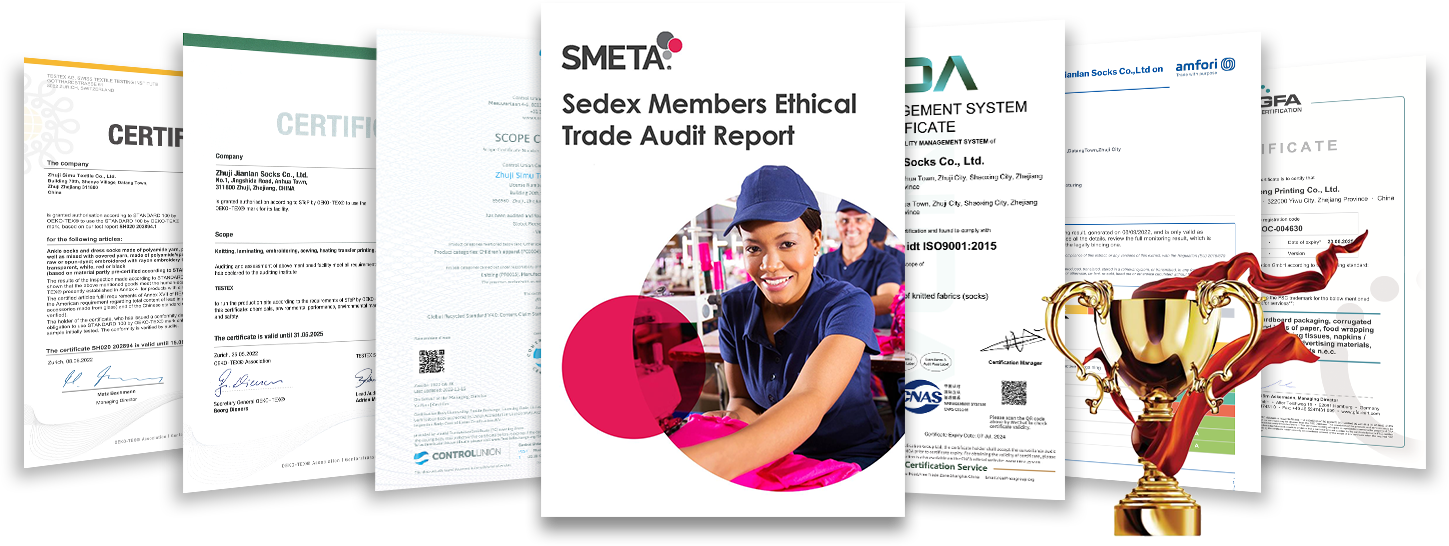
As one of the leading printing socks suppliers in China, we warmly welcome you to wholesale bulk hot sale unisex printing socks from our factory. All customized socks and tights are with high quality and low price. For OEM service, contact us now.
(0/10)



